


The Solar System Perspective Project
What?
| Cozy Mobile
Photo (detail) is from this page at NASA. |
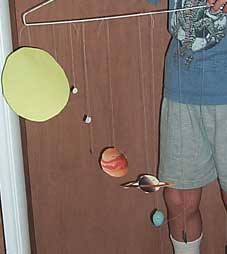
But it's completely wrong.
The solar system is basically empty. Oh, don't get me wrong: there are several objects in it which are many thousands of miles across. You're standing on one. But the distances between them are so staggering as to make even the sun insignificantly tiny by comparison. Taking the solar system as a whole, we're talking about invisible specks of dust hovering several hundred feet away from the head of a match.
It's difficult to imagine.
The Solar System Perspective Project is intended as an aid to the imagination, an attempt to dispel the grade school mobile by means of a more accurate model, built to scale. It provides the opportunity to observe the relative sizes of the planets and to walk the spaces between them. Viewers will be unlikely to use the word "astronomical" lightly in the future.
Installations
| The first installation of the SSPP took place at Stinson Beach, California, over Labor Day weekend 2004. The sun, represented by a five-foot weather balloon, was placed at the east end of the beach, with appropriately scaled objects for the planets located at appropriate distances according to their average orbits. A full report with pictures can be found HERE. | 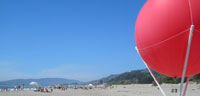 |
| The SSPP returned to Stinson Beach the weekend of September 17-18, 2005. Interesting things were learned, and we also took a few more pictures. The 2006 installation took place September 23-24 with a dazzling new sun model, and the event moved to spring (May 5-6) in 2007, so as to occur near the end of the school year instead of near Burning Man. We skipped 2008 because we were putting a lot of energy into an unusually elaborate marriage proposal (which probably should have a page of its own) and the resultant wedding. The project returned October 3-4 in 2009 and again September 15-16, 2012. Watch this space if you want to catch the next one. |
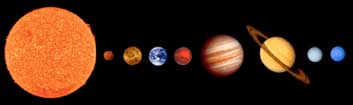 (photo outrageously not to scale) |
We think it's best to view these things by walking around in them, but for those who live prohibitively far away, or who don't enjoy the outdoors, or who would simply like an alternate presentation, we have also prepared a web version. Scrolling is not the same as walking, but you can still get the basic idea.
Beyond the Solar System
The scale of the installation at Stinson Beach is about a billion to one. At this scale the distance between the Earth and the Moon is a modest fifteen inches. If you walk from the sun to the farthest planet, Neptune, it's a little under three miles. If you wanted to walk from the sun to the nearest star (Proxima Centauri) you would have to go 25,000 miles - ALL THE WAY AROUND THE PLANET. And that's the CLOSEST star. To get from one side of the Milky Way galaxy to the other in our scale model, you'd have to walk all the way to Jupiter and then some (I mean the real Jupiter, not the model one). And then there are a bunch of other galaxies, besides, which are REALLY far away.More
We are not the only people to have thought of this. There are other true-to-scale models of the solar system in existence, and some places have permanent installations:- Eugene, OR
- Sonoma County, CA
- Silver City, NM
- Peoria, IL
- Cleveland, OH
- Aroostook County, ME
- Ithaca, NY
- Voorhees State Park, NJ
- Boston, MA
- Gainesville, GA
- Gainesville, FL
And of course there's always NASA for all sorts of fascinating stuff about the universe, and a lot of good pictures besides.